Why Cant Disney Just Renew Mickey Mouse Copyright Again
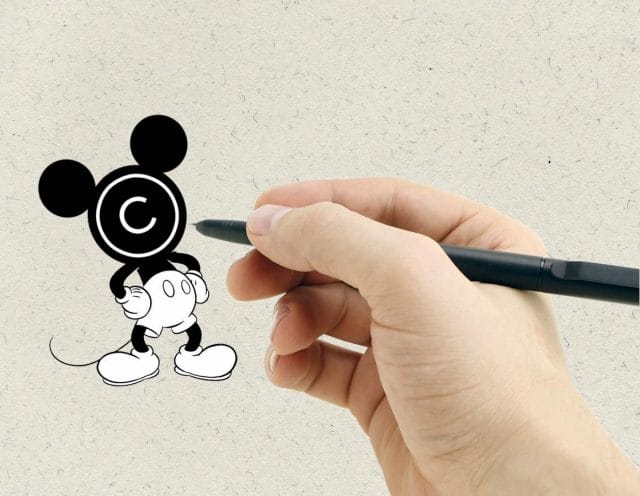

Mickey Mouse is, in the words of one copyright proficient, "a fucking powerhouse."
The lovable rodent, who sports bright ruby shorts, a pair of gigantic yellow shoes, and round ears, has accomplished, in his 87 years, what no other animated character has: He has won an University Accolade. He has spawned social clubs, theme parks, and every slice of merchandise imaginable. He has a worldwide make sensation of 97% — higher than Santa Claus. For his efforts, Forbes has dubbed him the earth'due south "richest fictional billionaire," placing his estimated worth to Disney at $5.viii billion per year.
For Disney, Mickey Mouse is non just a huge coin maker, just the company's virtually coveted slice of intellectual property. Mickey is Disney, and Disney is Mickey: the two are merely one and the aforementioned, and nothing is more of import to Disney than his well-existence. ("I love Mickey Mouse more whatsoever woman I take ever known," Walt Disney once famously said).
For this reason, Disney has washed everything in its power to make sure it retains the copyright on Mickey — fifty-fifty if that means irresolute federal statutes. Every time Mickey's copyright is almost to expire, Disney spends millions lobbying Congress for extensions, and trading campaign contributions for legislative support. With crushing legal force, they've squelched anyone who attempts to disagree with them.
In the age of the Internet, where vast swaths of creative fabric are freely available, the cardinal question raised by Mickey Mouse'southward copyright ordeal is particularly pertinent: Which is more important, a robust public domain, or the well-beingness of private interests?
The Invention of Mickey Mouse
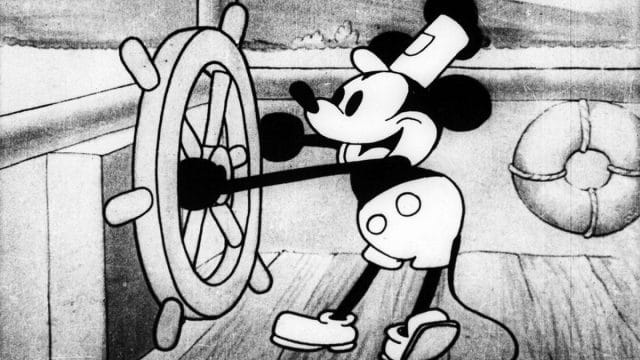
Mickey Mouse, in his debut as "Steamboat Willie" (1928); via Lafayette College
Three and a one-half years after founding his Los Angeles animation studio, Walt Disney was approached by his distributor, Charles Mintz, with an opportunity: Universal Studios was looking for a cartoon character.
Disney, who had only enjoyed moderate success upwardly to that bespeak and was still an unknown in the blitheness earth, happily took the job. In the early months of 1927, the 26-year-erstwhile Disney, along with his chief animator Ub Iwerks, designed Oswald the Lucky Rabbit — a rather saucy, anthropomorphic creature — and Mintz inked the deal with Universal. Oswald became a huge striking, and equally a upshot, Walt Disney Studios ballooned to 20 employees.
In 1928, at the meridian of Oswald's success, Mintz went behind Disney's back, stealing away about his unabridged blitheness team and re-signing them to a contract with Universal. When Disney's own contract with Mintz expired, he institute himself stripped of non simply his creation, just of his staff of animators. In the process, Disney learned a valuable lesson: he had to "e'er make certain that [he] owned all rights to the characters produced by [his] company."
"All he could say, over and over, was that he'd never work for anyone again every bit long as he lived," later recalled his married woman, Lillian. "He'd be his own boss."
Several months after, Disney and Ub Iwerks, who'd stayed loyal to him as an animator, hit the drawing board. In Disney's ain business relationship, Mickey Mouse was conceived out of desperation:
"We had to create a new character in a hurry to survive. And find a market for information technology. We canvassed all the brute characters nosotros thought suitable for the motion picture legend fashion of the time. All the good ones—the ones that would have instant appeal and would exist comparatively easy to draw—seemed to have been pre-empted by the other companies in the cartoon animate being field. Finally, a mouse was suggested, debated and put on the drawing boards every bit the best bet. That was Mickey."
On November 18, 1928, Mickey Mouse fabricated his official debut, in an animated short called "Steamboat Willie." Within v years, he became Hollywood's inanimate affiche child, raking in nearly $i million a year ($18 meg in 2022 dollars) in trade sales, soliciting University Award nominations, and inspiring children around the earth.
Having learned from his distributor'south previous betrayal, Disney clung to Mickey with an atomic number 26 grip. But like all fictional characters, Mickey faced an imminent future in the public domain — didn't he?
How Mickey Has Evaded Copyright Law
Copyright police in America long predated Mickey Mouse.
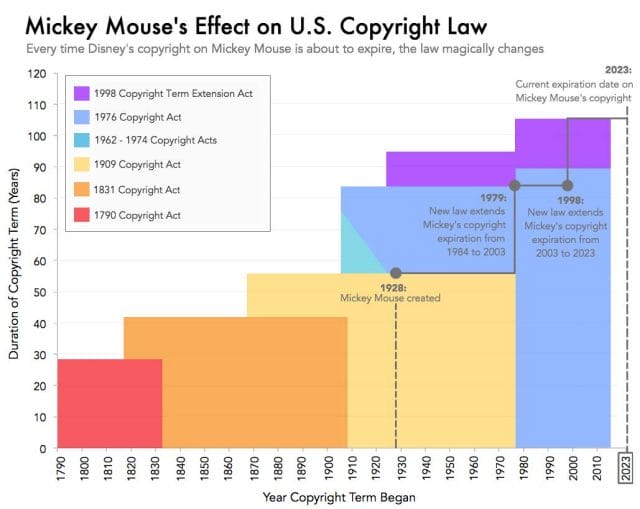
The starting time of these laws, the Copyright Human action of 1790, stipulated that creative works were entitled to up to 28 years of protection (14 years, plus an additional "renewal" menstruation of 14 years, supposing the original hadn't died). This was followed by an 1831 human activity, which extended the copyright period to a max of 42 years, and a 1909 deed, which elongated that period again, to 56 years. As the Fine art Police force Periodical clarifies, "very few works actually maintained [these] copyright durations": only a fraction of those who secured copyrights protected them, or opted to renew them.
Mickey Mouse was brought into the world in 1928, under the 1909 Copyright Act, entitling him to 56 years of protection under the law — no more. In accordance with the police, his copyright was prepare to expire in 1984.
Every bit this appointment drew virtually, Disney (the corporation) grew increasingly anxious. By this fourth dimension, Mickey was worth billions in annual revenue, and had become the face up of the company; losing him to the public domain would be a massive financial accident. Quietly, Disney took to Washington and began lobbying Congress for new copyright legislation.
In the nautical chart beneath, we've visualized every major copyright act, and overlaid how these acts take kept Mickey Mouse out of the public domain:
Zachary Crockett, Priceonomics; data via Tom W. Bell
Disney's efforts, and those of other multinational corporations with soon-expiring intellectual property, seem to have paid off. In 1976 — simply eight years prior to Mickey's expiration — Congress completely overhauled U.S. copyright police force to suit with European standards. This new police force expanded already-published corporate copyrights from 56 years to a maximum of 75 years. All works published prior to 1922 immediately entered the public domain; all works published later on 1922 (including Mickey Mouse) were entitled to the full 75 years of protection. Just like that, Mickey Mouse extended his copyright expiry xix years — from 1984 to 2003.
By the mid-1990s, Disney again began to feel the impending doom. In add-on to the 2003 expiration of Mickey's copyright, Pluto was set to expire in 2005, Goofy in 2007, and Donald Duck in 2009. The gang, collectively worth billions, had to be retained, then Disney began lobbying again.
In 1997, Congress introduced the Copyright Term Extension Deed, which proposed to extend corporate copyrights once more — this time, from 75 to 95 years. To ensure the bill passed, Disney cozied up to legislators.
Watchdog records testify that the Disney Political Action Committee (PAC) paid out a total of $149,612 in directly campaign contributions to those considering the bill. Of the beak'due south 25 sponsors (12 in the Senate, and 13 in the House), 19 received money from Disney's CEO, Michael Eisner. In one instance, Eisner paid Senate Bulk Leader Trent Lott (R-MS) $1,000 on the very aforementioned solar day that he signed on equally a co-sponsor.
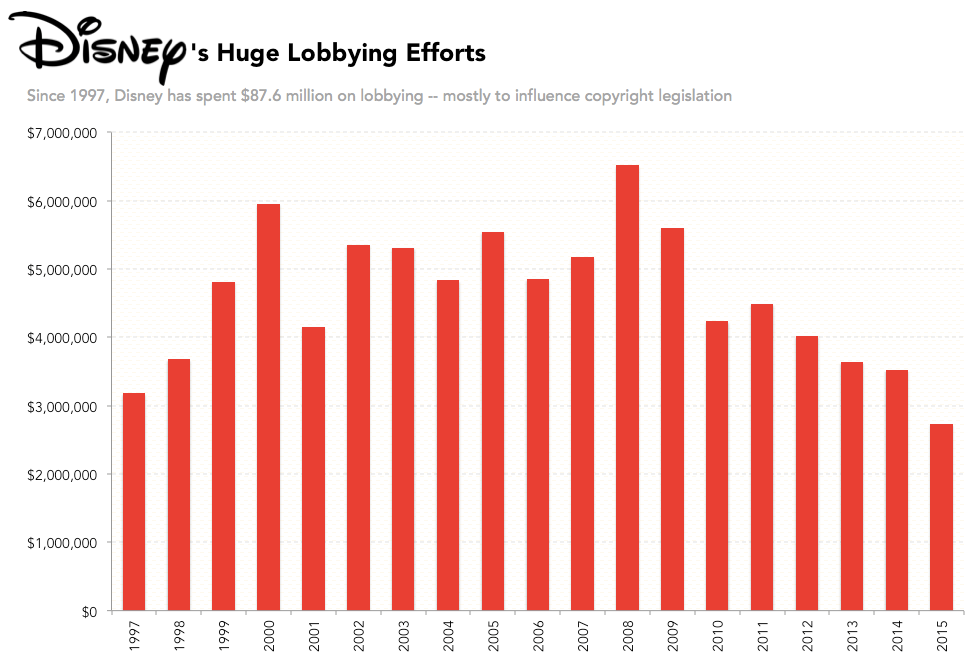
Zachary Crockett, Priceonomics; data via Open Secrets ; figures adjusted for inflation
"We regard our lobbying as proprietary to u.s.," Disney spokesman Thomas J. Deegan stated, when confronted past CNN in 1998. "We don't wish to talk nigh information technology."
While it is impossible to say for certain whether or not Disney's efforts directly impacted politics, the results heavily worked out in their favor: the bill quietly and unanimously passed in the House and Senate with no public hearings, no debate, no notice to the public, and no roll call.
On Oct 27, 1998, Mickey Mouse's copyright was extended another twenty years, to 2023.
In the entire congressional committee, only 1 man — Senator Hank Brown — opposed the bill. "The real incentive [was] for corporate owners that bought copyrights to lobby Congress for another xx years of revenue," he afterward said. "I thought it was a moral outrage. At that place wasn't anyone speaking out for the public interest."
Silent Protests
Via Flickr
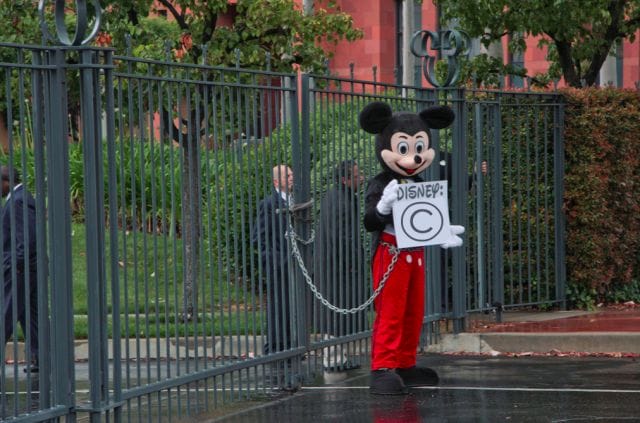
While Mickey Mouse's apparent ability to influence the law has been criticized, whatsoever major effort to rile upwardly the public has been squelched by Disney.
In the early 1970s, underground cartoonist Dan O'Neil published a serial of "raunchy, Mickey-taunting comics", depicting the mouse in various unsavory situations. He so formed a group chosen the "Air Pirates" (named subsequently a group of Mickey'due south villains from 1930s-era films), with the intent to alter the character to his own liking.
"Throughout my childhood, Mickey Mouse was used equally a placebo to lull me into thinking everything was alright," one of his accomplices later stated. "But I institute the happy-e'er-after globe of Walt and Mickey Mouse to be a poor half-truth. 'Air Pirates' shows that Mickey doesn't e'er win."
Eventually though, Mickey did win: Disney slapped O'Neil with a copyright infringement arrange, and eventually won a settlement of almost $200,000.
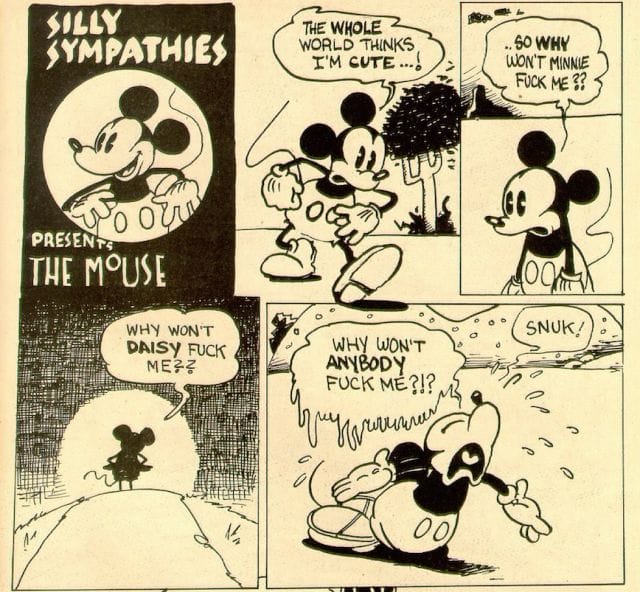
A underground cartoon from the 1970s inspired past the Air Pirates
In 1979, just a few years after Mickey's copyright was extended by Congress, O'Neil formed the "Mouse Liberation Front" in protestation. He recruited dozens of renegade cartoonists — all upset over the graphic symbol's copyright longevity — and barraged comic volume conventions with lewd pictures of the mouse. Disney immediately threatened another lawsuit, and O'Neil abandoned his campaign.
Years later on, in the wake of the 1998 Extension Human action, Eric Eldred, an Internet publisher who published works in the public domain, decided to "[challenge] the constitutionality of retroactively extending copyright terms." Eldred's counsel argued that Congress' power to expend copyrights invalidated the Constitution's claim that copyrights tin only be valid for a "limited" time.
In 2003, the case went all the way to the U.Southward. Supreme Court. But despite mounting support from the public to overturn the extension human action, the courtroom upheld it. In the opinion of Justice Ruth Bader Ginsburg, the linguistic communication set forth in the Constitution — that the role of the copyright was to "promote the progress of science and useful arts" — did non limit the power of Congress to change the law.
Should Mickey Mouse Be Ready Gratuitous?
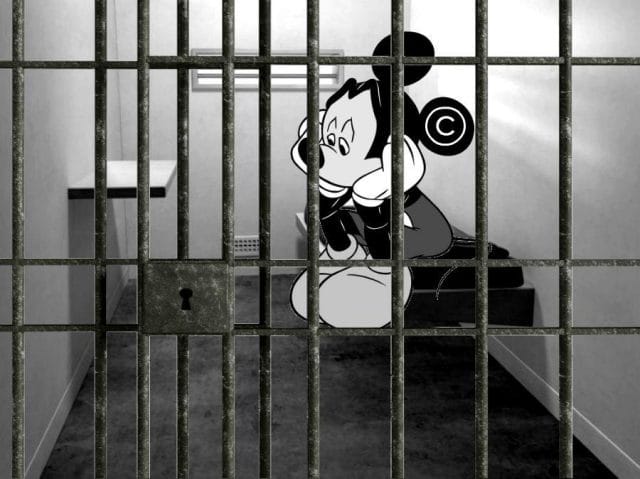
Today, Congress can modify the copyright term whenever it sees fit, making information technology entirely possible that Mickey Mouse'southward copyright will exist extended again before 2023. But should information technology? Does Disney'south cajoling of the police force serve any positive benefits to social club at large, or does it merely further enforce the repertoire of private interests?
Those in favor of copyright extensions more often than not fall back on iii major arguments: 1) Lengthy copyrights are necessary to incentivize the cosmos of new works; 2) Copyrighted works are an important source of income — not merely to copyright holders, but the U.S. at large; and, 3) Copyrights were originally intended to provide income for two generations of descendants; since human lifespan has increased since the original copyright bill in 1790, the copyright term should exist appropriately elongated.
"All of these arguments are either demonstrably false or, at best, without foundation in empirical information," copyright scholar Dennis Karjala tells u.s.a. over the phone. "The extensions are corporate welfare, plainly and unproblematic — and they have caused a lot of harm to the general public."
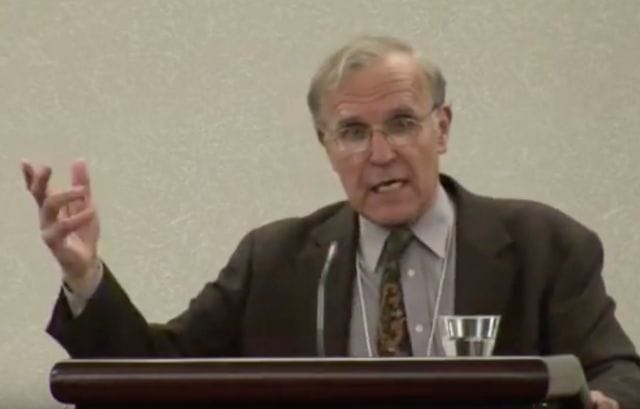
Dennis Karjala at a copyright law forum in 2007
Only what exactly are the "harms" Karjala is referring to? Why should the public care well-nigh copyright extension?
For one, research done by Paul J. Heald, a professor in the University of Illinois School of Law, has shown that copyright can "stifle the availability of work" to the general public. In a 2013 paper entitled How Copyright Keeps Works Disappeared, Heald crawled through more than 2,000 books on Amazon.com, and found that at that place were more books available from the belatedly 1800s than there were from the 1990s. His decision: "Copyright protections had squashed the market for books from the middle of the 20th century, keeping those titles off shelves and out of the hands of the reading public."
"Copyright correlates significantly with the disappearance of works rather than with their availability," writes Heald. In essence, his research endorses that copyright "makes books disappear", and copyright expiration "brings them back to life."
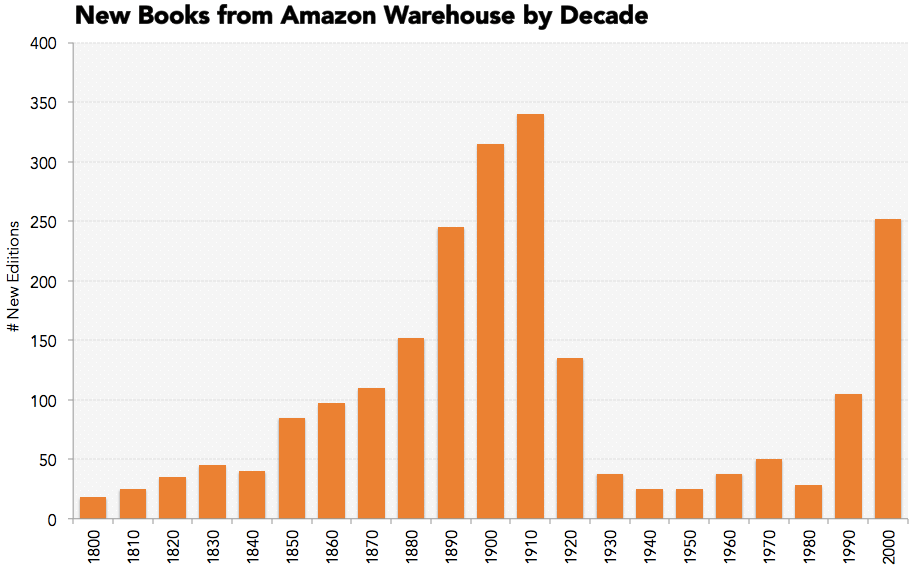
Priceonomics; Data via How Copyright Keeps Works Disappeared (Heald, 2013)
This particular statement doesn't seem to apply to Mickey Mouse. After all, it isn't every bit if copyright has shelled him off from lodge: he's still very much in the public spotlight, and millions of people savor him on a daily footing.
Yet, Karjala argues that copyright extensions have limited (if not altogether squashed) the public's freedom to brand derivative works. Moreover, he contends that they just serve to boost corporate profits for an elongated menstruation of time (the longer Mickey is copyrighted, the longer competition is minimized, allowing Disney to accuse more for its films and trade).
"The continued payment of [extended copyright] royalties is a wealth transfer from the U.Due south. public to current owners of these copyrights," he writes. "These copyright owners are in well-nigh cases large companies and, in any case, may non even be descendants of the original authors whose works created the revenue streams that started flowing many years ago."
While Disney continues to ardently fight for copyright legislation, more 50 of its own films — including blockbusters similar Alice in Wonderland, Aladdin, Frozen, and The King of beasts King — are based on works in the public domain:
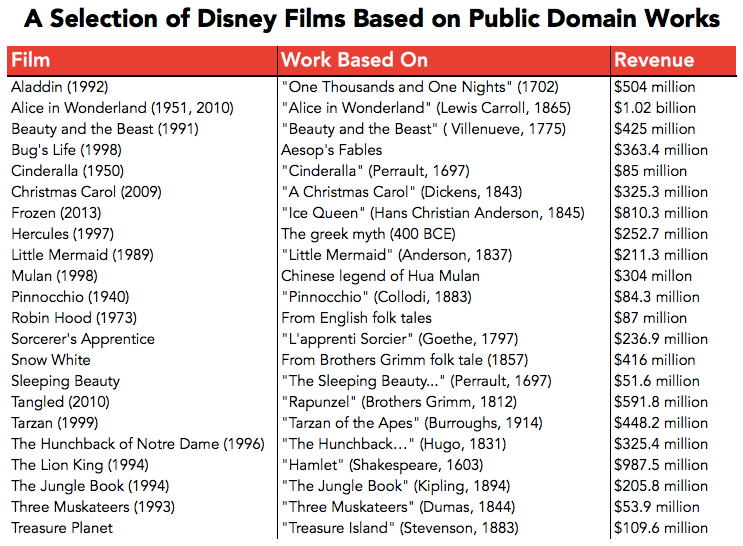
Zachary Crockett, Priceonomics; data via Forbes
Disney has taken full reward of expired copyrights without "paying into the system" with its ain original characters.
***
Ultimately, none of this may matter: Even if Mickey'south copyright does expire in 2023, Disney has no less than xix trademarks on the words "Mickey Mouse" (ranging from television shows and cartoon strips to theme parks and videogames) that could shield him from public utilize.
While a copyright protects works of art from existence manipulated by the public, a trademark "protects words, phrases and symbols used to identify the source of the products or services."
According a precedent prepare in a 1979 court case, a trademark can protect a character in the public domain as long every bit that graphic symbol has obtained what is called "secondary meaning." This ways that the character and the company are virtually inseparable: upon seeing it, one will immediately identify it with a brand. Copyright lawyer Stephen Carlisle contends that Mickey Mouse would meet this qualification with flying colors, should he need to:
"Disney has fabricated Mickey Mouse so prominent in all of their corporate dealings, that he is effectively the pre-eminent symbol of the Walt Disney Company. At that place can be little doubt that anyone seeing the image of Mickey Mouse (or fifty-fifty his silhouette), immediately thinks of Disney."
In other words, Disney has ingrained Mickey Mouse so deeply in its corporate identity that the character is essentially afforded legal protection for eternity, so long every bit Disney protects him (trademarks concluding indefinitely, then long every bit they are renewed).
Information technology'southward a sad truth for crusaders of the public domain: the more powerful and recognizable a slice of corporate property is (and thus, the more coveted it is by society at big), the less likely it is to be relinquished.

Our next post explains why you should tell bankers to take their credit card rewards and shove them up their asses. To go notified when we post it → join our email list .
This post was written pastZachary Crockett. You can f ollow him on Twitter at @zzcrockett
Source: https://priceonomics.com/how-mickey-mouse-evades-the-public-domain/
0 Response to "Why Cant Disney Just Renew Mickey Mouse Copyright Again"
Post a Comment