The Process of Shifting the Ribosome Down the Mrna to Read New Codons Is Termed

The ribosome assembles the polypeptide chain
To manufacture protein molecules, a cell must first transfer information from Dna to mRNA through the procedure of transcription. And so, a process called translation uses this mRNA as a template for protein assembly. In fact, this flow of information from DNA to RNA and finally to protein is considered the central dogma of genetics, and it is the starting point for understanding the function of the genetic data in DNA.
Just but how does translation work? In other words, how does the cell read and translate the information that is stored in DNA and carried in mRNA? The answer to this question lies in a series of complex mechanisms, nigh of which are associated with the cellular construction known equally the ribosome. In social club to understand these mechanisms, however, it's commencement necessary to take a closer expect at the concept known as the genetic code.
What is the genetic code?
At its heart, the genetic code is the set of "rules" that a prison cell uses to interpret the nucleotide sequence within a molecule of mRNA. This sequence is broken into a serial of iii-nucleotide units known as codons (Figure i). The iii-alphabetic character nature of codons ways that the 4 nucleotides found in mRNA — A, U, G, and C — can produce a total of 64 unlike combinations. Of these 64 codons, 61 stand for amino acids, and the remaining three stand for stop signals, which trigger the end of protein synthesis. Because there are only 20 different amino acids just 64 possible codons, near amino acids are indicated by more than than one codon. (Note, however, that each codon represents only 1 amino acid or stop codon.) This phenomenon is known as back-up or degeneracy, and it is important to the genetic code considering it minimizes the harmful effects that incorrectly placed nucleotides tin have on protein synthesis. Yet another factor that helps mitigate these potentially dissentious effects is the fact that there is no overlap in the genetic lawmaking. This means that the three nucleotides within a detail codon are a part of that codon but — thus, they are not included in either of the side by side codons.
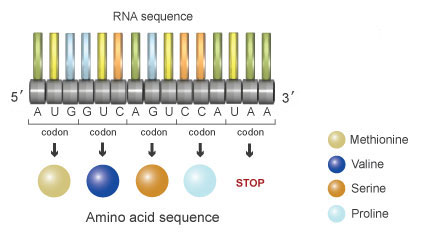
Figure 1: In mRNA, three-nucleotide units called codons dictate a particular amino acrid. For example, AUG codes for the amino acid methionine (beige).
The idea of codons was beginning proposed by Francis Crick and his colleagues in 1961. During that aforementioned twelvemonth, Marshall Nirenberg and Heinrich Matthaei began deciphering the genetic lawmaking, and they determined that the codon UUU specifically represented the amino acid phenylalanine. Following this discovery, Nirenberg, Philip Leder, and Har Gobind Khorana eventually identified the rest of the genetic lawmaking and fully described which codons corresponded to which amino acids.
Reading the genetic code
Redundancy in the genetic lawmaking means that virtually amino acids are specified by more than one mRNA codon. For case, the amino acid phenylalanine (Phe) is specified past the codons UUU and UUC, and the amino acid leucine (Leu) is specified by the codons CUU, CUC, CUA, and CUG. Methionine is specified by the codon AUG, which is also known as the start codon. Consequently, methionine is the first amino acid to dock in the ribosome during the synthesis of proteins. Tryptophan is unique because information technology is the but amino acrid specified by a single codon. The remaining nineteen amino acids are specified by between two and six codons each. The codons UAA, UAG, and UGA are the stop codons that bespeak the termination of translation. Figure 2 shows the 64 codon combinations and the amino acids or stop signals they specify.
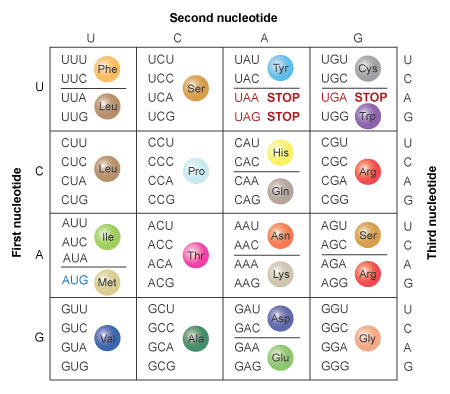
Figure 2: The amino acids specified by each mRNA codon. Multiple codons tin lawmaking for the same amino acrid.
What part exercise ribosomes play in translation?
As previously mentioned, ribosomes are the specialized cellular structures in which translation takes place. This means that ribosomes are the sites at which the genetic code is actually read by a cell. Ribosomes are themselves composed of a complex of proteins and specialized RNA molecules called ribosomal RNA (rRNA).

Figure 3: A tRNA molecule combines an anticodon sequence with an amino acid.
During translation, ribosomes movement forth an mRNA strand, and with the aid of proteins called initiation factors, elongation factors, and release factors, they get together the sequence of amino acids indicated by the mRNA, thereby forming a poly peptide. In order for this associates to occur, however, the ribosomes must be surrounded by small-scale but critical molecules called transfer RNA (tRNA). Each tRNA molecule consists of two singled-out ends, i of which binds to a specific amino acrid, and the other which binds to a specific codon in the mRNA sequence because it carries a serial of nucleotides called an anticodon (Figure 3). In this way, tRNA functions every bit an adapter between the genetic bulletin and the protein product. (The verbal role of tRNA is explained in more depth in the post-obit sections.)
What are the steps in translation?
Like transcription, translation can too exist broken into three distinct phases: initiation, elongation, and termination. All three phases of translation involve the ribosome, which directs the translation procedure. Multiple ribosomes can translate a unmarried mRNA molecule at the aforementioned time, but all of these ribosomes must begin at the beginning codon and motility along the mRNA strand one codon at a time until reaching the stop codon. This group of ribosomes, also known as a polysome, allows for the simultaneous product of multiple strings of amino acids, called polypeptides, from ane mRNA. When released, these polypeptides may exist complete or, as is often the instance, they may require further processing to become mature proteins.
Initiation

Figure four: During initiation, the ribosome (grayness earth) docks onto the mRNA at a position most the kickoff codon (scarlet).
At the commencement of the initiation phase of translation, the ribosome attaches to the mRNA strand and finds the kickoff of the genetic bulletin, chosen the start codon (Figure four). This codon is well-nigh e'er AUG, which corresponds to the amino acid methionine. Adjacent, the specific tRNA molecule that carries methionine recognizes this codon and binds to it (Effigy 5). At this point, the initiation stage of translation is complete.

Figure 5: To complete the initiation stage, the tRNA molecule that carries methionine recognizes the showtime codon and binds to it.
Elongation
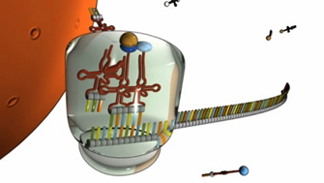
Figure half-dozen: Within the ribosome, multiple tRNA molecules bind to the mRNA strand in the appropriate sequence.

Effigy vii: Each successive tRNA leaves behind an amino acrid that links in sequence. The resulting chain of amino acids emerges from the pinnacle of the ribosome.
The next stride in translation, called elongation, begins when the ribosome shifts to the next codon on the mRNA. At this point, the corresponding tRNA binds to this codon and, for a short fourth dimension, in that location are two tRNA molecules on the mRNA strand. The amino acids carried by these tRNA molecules are then leap together. After this binding has occurred, the ribosome shifts again, and the start tRNA, which is no longer connected to its respective amino acrid, is released (Effigy six). Now, the third codon in the mRNA strand is ready to demark with the appropriate tRNA (Figure vii). Once over again, the tRNA binds to the mRNA strand, the third amino acid is added to the series, the ribosome shifts, and the second tRNA (which no longer carries an amino acid) is released. This process is repeated along the entire length of the mRNA, thereby elongating the polypeptide chain that is emerging from the top of the ribosome (Figure 8).

Figure 8: The polypeptide elongates every bit the process of tRNA docking and amino acid attachment is repeated.
Termination
Eventually, after elongation has proceeded for some time, the ribosome comes to a cease codon, which signals the end of the genetic message. Every bit a result, the ribosome detaches from the mRNA and releases the amino acid concatenation. This marks the final phase of translation, which is called termination (Figure nine).
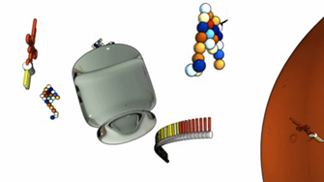
Figure ix: The translation process terminates subsequently a cease codon signals the ribosome to fall off the RNA.
What happens subsequently translation?
For many proteins, translation is merely the first step in their life cycle. Moderate to extensive post-translational modification is sometimes required before a protein is consummate. For example, some polypeptide chains require the addition of other molecules earlier they are considered "finished" proteins. Still other polypeptides must have specific sections removed through a process chosen proteolysis. Often, this involves the excision of the offset amino acid in the chain (unremarkably methionine, as this is the particular amino acrid indicated past the start codon).
Once a protein is complete, it has a job to perform. Some proteins are enzymes that catalyze biochemical reactions. Other proteins play roles in Deoxyribonucleic acid replication and transcription. Yet other proteins provide structural back up for the cell, create channels through the cell membrane, or deport out i of many other of import cellular support functions.
Watch this video for a summary of translation in eukaryotes
Source: https://www.nature.com/scitable/topicpage/the-information-in-dna-determines-cellular-function-6523228/
0 Response to "The Process of Shifting the Ribosome Down the Mrna to Read New Codons Is Termed"
Post a Comment